


Tinted Motorcycle Visors. Are they REALLY Illegal!?

Apparently, blocking 85% of sunlight is perfectly acceptable in a car, but do it on a motorcycle and you could be breaking the law. And according to one police officer on TikTok, you might even find your insurance refusing to pay out.

Same sunshine. Same road. Same amount of light reaching your eyes. The only difference is whether the tint is attached to your face or your helmet.
And somehow, we're supposed to believe one is perfectly reasonable while the other is potentially dangerous enough to warrant prosecution.
I watched a TikTok last night featuring a police officer visiting a motorcycle dealership to warn riders about tinted visors. By the end of it, I was genuinely irritated. Not because I think riders should be allowed to wear whatever they like regardless of safety, but because the rules seem to defy common sense, and the suggestion that your insurance could be invalidated only adds to the nonsense.
So let's look at two very ordinary scenarios and you can decide whether any of this makes sense.
A Beautiful Winter Afternoon, Two Vehicles, One Ridiculous Contradiction
It's a crisp winter afternoon in the UK. The roads are slightly damp, the sky is perfectly clear and the sun is sitting just above the horizon, shining directly into my eyes as I head west.

Anyone who drives or rides through a British winter knows exactly what I'm talking about. That horrible, blinding sunlight that catches every reflection on the road, illuminates the dirt on your windscreen and makes it almost impossible to distinguish what's happening ahead of you.
I'm in my car, and despite the sun visor being down, I'm struggling to see. So I reach for my trusty black Ray-Bans, pop them on and immediately things become more manageable. I'm still squinting occasionally, but the reduction in glare means I can actually see the road, the junctions and the other vehicles around me.
Those Ray-Bans probably transmit somewhere between 8% and 18% of visible light, assuming they're typical Category 3 lenses. In other words, they're blocking more than 80% of the light reaching my eyes.
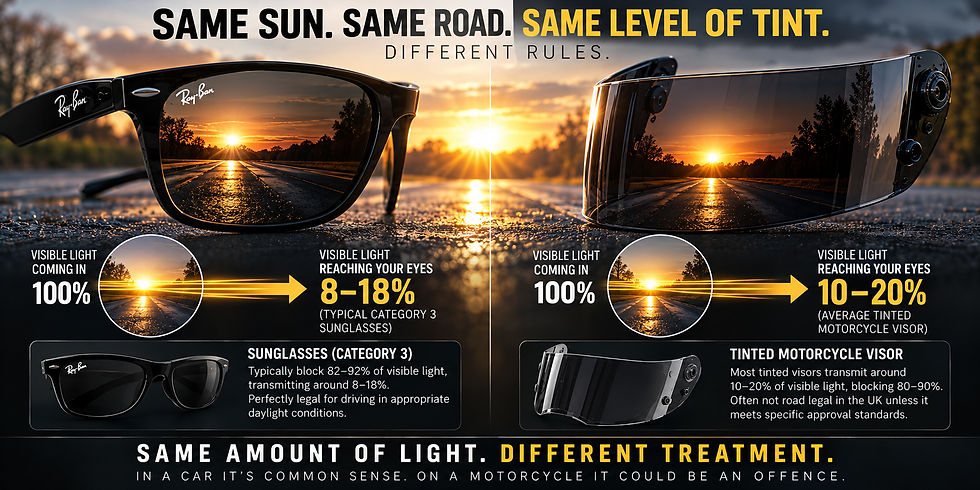
Perfectly legal in appropriate daylight conditions.
Now let's rewind and put me on my motorcycle, riding along exactly the same stretch of road in exactly the same conditions.
The sun is still sitting on the horizon, the damp tarmac is reflecting the light straight into my face and, unlike my car, I don't have a sun visor hanging from the roof that I can pull down. My clear helmet visor offers precious little protection against the glare, and I'm squinting so hard that I'm struggling to make out what's happening ahead.
I could slow down, pull over and wait for the sun to move, but that isn't always particularly practical. I could wear sunglasses under my helmet, although depending on the helmet and the glasses, that can be uncomfortable. Or I could use the dark smoke visor I've got with me, which makes an enormous difference to my ability to see.
So I fit the dark visor. It has no recognised approval marking, and for the purposes of this example, let's assume it transmits around 15% of visible light, roughly the same as my Ray-Bans.
Suddenly I can see properly again.
Except now, according to UK motorcycle eye-protection regulations, I've potentially committed an offence.
Same road, same sunshine, same amount of light reaching my eyes and the same person operating a motor vehicle. Yet the sunglasses are generally permitted while the dark visor isn't.
How on earth does that make sense?
Now Let's Have an Accident
A little further down the road, a car pulls out of a junction directly in front of me, leaving insufficient time or distance to avoid a collision.
In the first scenario, I'm driving my car wearing my Ray-Bans. There's a collision, the vehicles are damaged, but thankfully nobody is injured. The police arrive, take statements, examine the scene and establish what happened. I've taken my sunglasses off by this point, and unless there's some reason to investigate my visibility, there's a reasonable chance nobody will even ask whether I was wearing them.
Now imagine the identical incident on my motorcycle. The car pulls out, I collide with it and, once again, I'm fortunate enough to walk away. By the time the police arrive, I've removed my helmet, and the dark visor is sitting on it for everyone to see.
This time, however, there's potentially a separate offence to investigate, because my visor doesn't meet the standards required for road use.
And according to the warning in that TikTok, I could also find myself having problems with my insurance.
Hang on a minute.
In both scenarios, the accident happened because another vehicle pulled out in front of me. In both scenarios, I was using eyewear that transmitted approximately the same amount of light. In both scenarios, the eyewear actually helped me see through the glare rather than making my vision worse.
Yet in one scenario nobody is likely to bat an eyelid, while in the other I could face questions about my equipment and possibly my insurance cover.
I'm sorry, but that's bullshit.

And before somebody points it out, yes, sunglasses could absolutely become relevant to an investigation if visibility was a contributing factor. The police can investigate what a driver was wearing, and if the sun had already dropped below the horizon, wearing dark glasses could be a very different proposition.
But that rather reinforces my argument. Surely the relevant question should be whether I could see properly and whether my visibility contributed to the accident, rather than whether the tint was attached to a pair of Ray-Bans or a motorcycle helmet.
What Does the Law Actually Say?
Tinted Motorcycle Visors. Are they REALLY Illegal? Here's where things get interesting, because the legislation isn't quite as straightforward as the occasional social media lecture might suggest.
Section 18 of the Road Traffic Act 1988 provides the legal framework for motorcycle eye protectors, while the Motor Cycles (Eye Protectors) Regulations 1999 specify the recognised standards that those protectors must satisfy.
The law doesn't simply contain a sentence saying that dark motorcycle visors are illegal whenever they transmit less than 50% of sunlight. Instead, the regulations refer to technical approval standards, and the Department for Transport explains that visors transmitting less than 50% of visible light do not fully comply with those standards for road use.
That distinction doesn't make the rules imaginary or unenforceable. They are real legal requirements, and using a non-compliant visor can constitute an offence.
But it does raise a rather obvious question about how those requirements are enforced.
If a police officer stops me wearing a dark visor, how exactly are they establishing how much light it transmits? Are they carrying a calibrated light-transmission meter? Have they identified the visor's manufacturer and checked its specifications? Or have they simply decided that it looks too dark?
An officer can inspect approval markings and gather other evidence, and there's no universal requirement to conduct a roadside light-meter test before taking action. Equally, an officer's personal impression of how dark something looks is not the same thing as a scientific measurement.
If the allegation specifically concerns light transmission, I'd expect there to be credible evidence supporting it. A prosecution still has to prove the offence to the criminal standard, and an unsupported guess should be open to challenge.
What I find particularly frustrating is that the rules appear to focus so heavily on the specification of the equipment, while paying comparatively little attention to the real-world conditions in which it's being used.
A dark visor might be entirely inappropriate on a gloomy November evening, but extremely useful when the low winter sun is making it difficult to see the road ahead. Context matters, and pretending otherwise doesn't make motorcycling safer.
And Then There's the Insurance Scaremongering
The TikTok also suggested that wearing a dark visor could result in your insurance not paying out following an accident, particularly if your visibility was restricted.
Now, technically, there are circumstances in which non-compliant equipment or restricted vision could complicate an insurance claim. I'm not going to pretend otherwise.
But there's an enormous difference between saying that something could become relevant to an insurance dispute and implying that wearing a dark visor automatically invalidates your insurance.
It doesn't.
Motor insurance law is considerably more complicated than that. Section 148 of the Road Traffic Act 1988 protects compulsory third-party insurance against certain policy exclusions, while other insurance legislation can limit an insurer's ability to rely on particular policy breaches that were irrelevant to the loss.

That doesn't guarantee that every claim for damage to your own motorcycle will be paid, and it certainly doesn't mean riders can ignore the law without consequences. It does mean that an insurer can't simply be assumed to have a blanket right to refuse everything because a rider was wearing an illegal visor.
In my hypothetical collision, if the car driver pulled out without looking and the tint played no part in what happened, I'd want to know precisely what legal and contractual grounds an insurer was relying on before accepting that the visor justified refusing a claim.
And if the argument is that my vision was restricted, then surely the same scrutiny should apply to the car driver wearing equally dark sunglasses?
That's what bothers me about these social media warnings. They take a complicated legal issue, remove almost all the context and reduce it to something designed to frighten people into compliance.
Safety Should Be About Seeing, Not Ticking Boxes
I understand why motorcycle visors need to meet safety standards. They must offer suitable optical clarity, resist impacts and protect riders from debris, wind and the elements. Nobody sensible is arguing that we should abandon those requirements.
I also understand why manufacturers and regulators need consistent standards. You can't have a different law for every combination of sunshine, weather and road conditions.
But I struggle to understand why a motorcyclist wearing Category 3 sunglasses beneath a clear visor is treated differently from one using a visor with equivalent light transmission, particularly when the latter might provide a more comfortable, unobstructed field of vision.
There may be genuine technical reasons for distinguishing the two, and I'd be interested to see the evidence behind them. What I don't accept is that pointing to a regulation automatically answers the question of whether that regulation makes sense.
The Department for Transport has considered allowing darker visors for daytime use before. In a parliamentary answer in 2007, the government explained that the proposal had been rejected following concerns about changing light conditions.
Fair enough. Light conditions change, and riders need to be able to adapt.
But light conditions also change when you're wearing sunglasses in a car, and somehow we've managed to cope with that without imposing an equivalent 50% transmission limit on every pair of Ray-Bans.
Of course, I can take my sunglasses off when the light fades. I can also lift my visor, stop and change it, or use a helmet with a retractable internal sun visor. None of those options removes the need for common sense.
Perhaps It's Time We Revisited This
I'm not suggesting that riders should deliberately break the law, and I'm certainly not recommending wearing an unapproved dark visor on public roads. The legal consequences are real, even if I disagree with the reasoning behind them.
What I'm questioning is whether the current approach genuinely reflects the realities of riding a motorcycle, particularly in a country where low winter sunshine, wet roads and rapidly changing visibility are everyday hazards.
If two pieces of eyewear allow essentially the same amount of light through, why should one be treated as acceptable and the other potentially result in prosecution?
And why are we frightening riders with suggestions that their insurance might be invalidated without properly explaining the circumstances in which that could actually happen?
I've spent enough time riding motorcycles, both on the road and on the track, to know that visibility is fundamental to safety. If I can't clearly see what's happening ahead, I'm not riding safely, regardless of whether the equipment I'm wearing has the correct approval stamp.
I'd rather have a regulation that genuinely helps riders see the road than one that simply looks good on a compliance checklist.
Perhaps instead of producing another TikTok warning riders about dark visors, somebody could explain why sunglasses blocking 85% of the light are acceptable while a visor doing exactly the same thing isn't.
Because at the moment, I'm struggling to see the logic.
And no, that's not because I'm wearing a dark visor. But I am...
Useful legal references


Comments