


Bad Driving Is Contagious — and Britain’s Motorways Are Spreading It

Five hours on the motorway left me wondering whether our biggest road-safety problem is speed, distraction, poor training—or the frustration one bad driver creates in everybody else.

Bad Driving Is Contagious — and Britain’s Motorways Are Spreading It?
I spend around five hours travelling between Northamptonshire and Essex on the weekends I see my children. It is enough time on the M1, M25 and surrounding roads to notice patterns—and on my latest journey, one pattern was impossible to ignore.
The standard of driving was appalling.
I saw more than ten cars wandering within their lanes or drifting towards another. When I eventually drew level, the explanation was frequently sitting in the driver’s lap: a mobile phone, a navigation app or some other screen receiving more attention than the road.
I watched cars remain in lanes two and three while lane one was almost completely empty. I saw a driver travelling at less than 50mph, forcing one HGV after another to pull out and creating a rolling blockage behind them. I then lost around 40 minutes because traffic on our carriageway slowed to inspect a collision on the opposite side of the motorway.
None of that will sound unusual to anyone who regularly drives in Britain. That may be the most worrying part.
Bad driving does not happen in isolation
It is easy to blame the first inconsiderate driver and leave it there. But what I witnessed was a chain reaction.
One person sits in the wrong lane. The traffic behind begins to bunch. A driver flashes their lights. Someone else gets impatient and undertakes. Another car cuts across two lanes to reclaim a few metres. Braking ripples backwards, tempers shorten and people who might ordinarily drive sensibly begin making increasingly aggressive decisions.
Bad driving is contagious.

That does not excuse the person who tailgates, weaves between lanes or responds with road rage. Frustration is not permission to drive dangerously. But if we genuinely want safer, faster and less congested roads, we must understand the whole sequence—not just punish the most dramatic final act.
The person staring at a phone, the motorist occupying the wrong lane and the angry driver cutting through traffic are all contributing to the same dangerous environment.
Britain recorded 1,538 road deaths during 2025. A further 29,918 people were killed or seriously injured, an increase of 4% on the previous year. Those figures should stop us treating distraction, poor observation and lane discipline as minor annoyances.
There is no “fast lane”
Part of the problem may be the language we use. Motorways do not have a slow lane, a middle lane and a fast lane. They have lane one and additional lanes for overtaking. The Highway Code is clear: keep left unless you are overtaking.
Yet many drivers seem to select a lane according to the speed they intend to travel and remain there indefinitely. On a four-lane motorway, it is now common to find lanes one and two almost empty while a queue forms in lanes three and four.
This reduces the effective capacity of the road, forces other drivers to make unnecessary lane changes and creates conflict between those who refuse to move left and those determined to get past at any cost.
Would better publicity help? Probably. Should persistent lane hogging be enforced more consistently? Almost certainly. But lane discipline should also be properly taught and assessed rather than mentioned once in a theory book and assumed to remain with somebody for the next 60 years.
Learners can receive motorway tuition with an approved instructor, but motorway competence is not a compulsory element of the practical driving test. Joining at speed, overtaking HGVs, maintaining safe gaps and understanding how unnecessary braking creates traffic waves are significant skills. We should treat them that way.
The screen in your hand—and the one built into your dashboard
The obvious target is the mobile phone. Using one at the wheel is illegal, socially condemned and still astonishingly common.
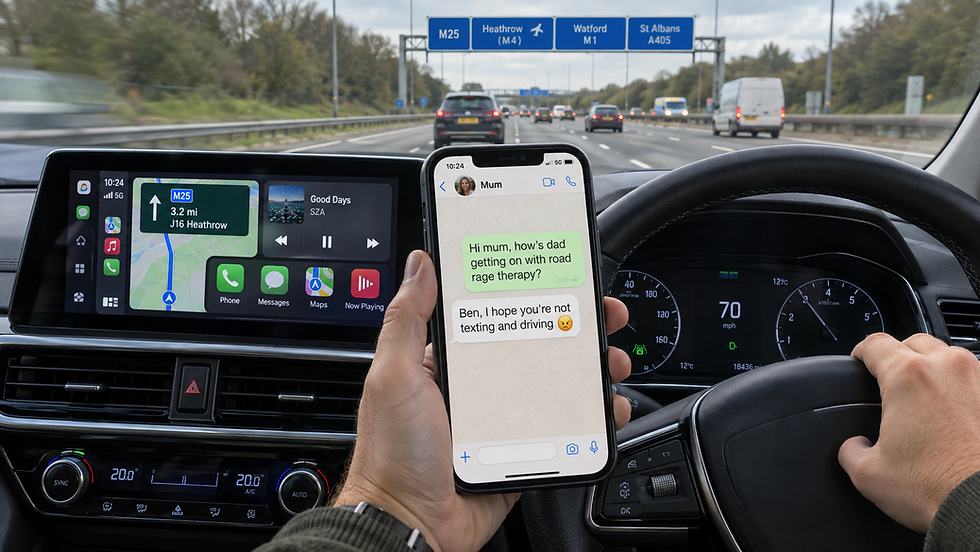
Technology companies know when a device is travelling at motorway speed. They know whether it is connected to a vehicle and, in many cases, whether navigation is running. Why, then, can a driver still type a destination, scroll through messages or interact with complex applications while moving?
A sensible driving mode could suppress notifications, disable keyboard entry and restrict navigation changes to voice control whenever a phone is connected to a moving vehicle. There would need to be passenger overrides, emergency access and protections for accessibility requirements. GPS speed alone cannot determine whether somebody is driving, riding in the passenger seat or sitting on a train.
But “it is technically complicated” is no longer a convincing reason to do almost nothing.
Vehicle manufacturers must accept some responsibility too. In the name of modernity, many have replaced buttons that could be operated by touch with layered touchscreen menus that demand visual attention. We prohibit a driver from holding a phone, then sell them a car in which changing a basic setting can require several taps on a tablet mounted to the dashboard.
Common controls should remain physical. Complex menus should be restricted while moving. Any system intended for use on the road should have a measurable maximum eyes-off-road time.
The battered courier van is telling us something
There is another familiar sight on British roads: the unmarked delivery van bearing a dent or scrape on almost every panel.
That is a sweeping observation, and it would be unfair to label every courier a bad driver. Many are highly skilled people doing a difficult job under relentless pressure. But the way some delivery vehicles are driven raises a question about the system behind the person at the wheel.
Couriers can face unrealistic drop numbers, routes with insufficient allowance for congestion or parking, constant interaction with navigation and delivery applications, and performance measures linked to speed or completed deliveries. Some are paid by the drop. Many operate as contractors or within the gig economy, where losing time can mean losing income.
That environment predictably encourages rushing, stopping wherever possible and interacting with technology between—or during—deliveries.
The driver remains responsible for their actions. But the company that creates an impossible schedule should not be able to transfer every consequence onto the individual.
The Health and Safety Executive already says employers must manage work-related road risks including fatigue, distraction and time pressure. Its guidance explicitly includes couriers, delivery drivers, gig workers and dependent contractors. The question is whether that responsibility is being enforced strongly enough.
There is also a striking regulatory gap. A standard category B licence allows somebody to drive a petrol or diesel van with a maximum authorised mass of up to 3,500kg. They could then spend the majority of every working day driving it commercially without acquiring an additional professional qualification.
An HGV driver, by contrast, must obtain a Driver Certificate of Professional Competence and complete 35 hours of periodic training every five years.
Vehicle weight matters, but so does exposure. Someone driving a van for ten hours a day, under time pressure and making scores of stops, presents a different risk from someone using a car to visit the supermarket.
Professional van and courier drivers should complete a proportionate light-commercial qualification covering motorway driving, urban hazards, vulnerable road users, fatigue, loading, safe stopping and the use of navigation equipment.
Operators should also have to demonstrate that routes can be completed legally and safely, without penalising drivers for proper breaks or unavoidable delays.
If a factory required someone to operate machinery at an unsafe pace, we would examine the employer’s processes. We should apply the same logic when the machinery has four wheels and shares the road with the public.
Could technology police the problem?
Artificial intelligence will not compensate for bad policy, but it could improve enforcement.

Camera systems can already help identify possible mobile-phone and seatbelt offences. Similar systems might flag persistent lane hogging, dangerous following distances or erratic movement. Any suspected offence should still be reviewed by a trained person before action is taken; context, accuracy and a proper appeals process matter.
Britain could also create one consistent national portal for submitting dashcam footage. Some police forces already accept footage through schemes such as Operation Snap, but the experience varies by area. A national system could extract the time, location and registration, detect incomplete footage, identify repeat reports and send credible cases for human review.
It should not automatically punish—or even formally warn—a registered keeper simply because somebody uploads a clip. Evidence can be edited, disputes have two sides, and public reporting systems can be abused. Technology should make credible enforcement easier, not replace due process.
What about older and overseas-trained drivers?
It is tempting to turn every observation into a judgement about a particular age or community. That would generate heat but very little useful light.
You cannot reliably know somebody’s nationality, licence history, medical fitness or where they learned to drive by looking through their window. What we can reasonably ask is whether every person using British roads has demonstrated current competence in the environment in which they are driving.
Road cultures, lane discipline and enforcement vary enormously between countries. A neutral motorway-familiarisation requirement would help anyone whose previous experience did not prepare them for British motorways—without making assumptions based on appearance.
Likewise, age alone is an imperfect measure. Some people remain excellent drivers well into later life; others become unsafe much earlier. Regular eyesight checks, hazard-perception refreshers and evidence-based practical assessments would be fairer than either ignoring declining ability or treating every older driver as a danger.
Driving licences should not represent competence demonstrated once, decades ago. A short Highway Code and hazard-awareness refresher at renewal would be a modest expectation for everybody.
Could more motorcycles be part of the answer?
This is where motorcycling enters the argument—not because motorcyclists are morally superior, but because powered two-wheelers use road space differently.
If more suitable journeys were made by motorcycle or scooter, fewer cars would occupy the road and fewer parking spaces would be required. Filtering allows motorcycles to move through stationary or slow traffic rather than simply adding another full-width vehicle to the queue. A commuter on a 125cc machine does not need two tonnes of metal and several square metres of road to transport one person to work.
Greater numbers of motorcycles could also make drivers more accustomed to looking for them. At present, bikes can be treated as occasional surprises. In places where powered two-wheelers are a routine part of traffic, their presence becomes something drivers expect rather than something they notice too late.
That does not mean forcing everyone onto a motorcycle, nor pretending every journey suits one. It means recognising motorcycles and scooters as part of transport policy—not merely weekend leisure products.
Motorcycling can also demand a greater level of active involvement. You cannot casually reach into a footwell, eat a meal or stare into your lap in quite the same way when balance, positioning and exposure require constant attention.
But riders should resist becoming smug, because we are rapidly importing the same distractions.
Bluetooth headsets arrived first. Then came phones mounted to handlebars, turn-by-turn navigation, music, group intercoms and messages read aloud inside helmets. Apple CarPlay and Android Auto now appear on motorcycles, while larger colour displays offer increasingly complicated menus.

At the same time, manufacturers are racing to mitigate risk through cornering ABS, traction control, blind-spot monitoring, adaptive cruise control and radar-assisted braking warnings. These systems can be valuable, but there is an uncomfortable contradiction in adding more technology to attract a rider’s attention while adding still more technology to rescue them when that attention wanders.
A motorcycle interface should be designed on the assumption that the rider cannot safely study it. Essential information must be glanceable. Complex inputs should be disabled while moving. Voice prompts should be concise. Manufacturers should resist copying car dashboards simply because larger screens look impressive in a showroom.
Riders must make sensible choices too. A helmet headset playing directions at a sensible volume is not equivalent to typing on a phone, but calls, conversations, music selection and repeated screen interaction all consume attention. We cannot condemn distracted drivers while behaving as if our own connected devices are harmless.
The answer is not one more fine
There is no single cure for what I witnessed during those five hours.
It will require better initial training, meaningful refreshers, clearer motorway education and greater enforcement of distraction and lane discipline. It will require technology companies to take responsibility for how devices behave in moving vehicles, manufacturers to design interfaces around attention rather than novelty, and delivery businesses to stop treating road risk as the courier’s problem alone.
It also requires a more intelligent transport conversation. A road network carrying more motorcycles and scooters could move more people using less space, reduce congestion and make the presence of vulnerable road users part of everyday driver awareness. But motorcycling earns that place only if riders acknowledge their own capacity for distraction and use technology responsibly.
Most importantly, we must stop treating poor driving as something that affects only the person doing it. One distracted driver causes a hesitation. One unnecessary hesitation causes braking. Braking creates congestion. Congestion creates frustration, and frustration encourages somebody else to take a risk.
Bad driving is contagious—but better standards can be contagious too.
So, if you could make one change tomorrow, what would it be: compulsory motorway training, periodic driver assessments, tougher phone restrictions, professional qualifications for couriers, better enforcement—or encouraging more people to commute on two wheels?


Comments