


Loud Pipes Save Lives? Do They?


Police and Crime Commissioner Donna Jones is calling for tougher action on excessively noisy vehicles, including enforceable roadside noise limits and the wider use of acoustic cameras. Motorcyclists have been defending loud exhausts for decades, often under the banner of ‘loud pipes save lives’, but is there actually any truth in it? More importantly, are we at risk of creating nationwide restrictions to tackle what is predominantly a localised anti-social behaviour problem?
Today I read a story about Hampshire Police and Crime Commissioner Donna Jones calling on the Government to take “clear, decisive action” against illegally modified and excessively noisy vehicle exhausts. On face value, I suspect many motorcyclists will have exactly the same reaction I did: we’ve heard all this before.
The battle between residents, authorities and noisy vehicles is hardly new. For as long as I’ve been riding motorcycles there have been calls for tougher exhaust regulations, increased enforcement and restrictions around popular meeting spots. Yet the more I thought about Jones’ proposals, the more questions started rattling around inside my head.
Why are motorcyclists so obsessed with making our bikes louder? Do aftermarket exhausts still provide meaningful performance benefits? Is there any truth behind the age-old claim that ‘loud pipes save lives’? What actually constitutes a legally ‘too loud’ motorcycle in Britain, and if the law already exists, why is new legislation needed at all?
Perhaps most importantly, are loud exhausts really the problem – or is it the way a small number of people use them?
What’s actually being proposed?
It’s important to make one thing clear from the outset: Donna Jones isn’t campaigning to make excessively loud exhausts illegal. In many circumstances, they already are.

UK legislation already prohibits modifying an exhaust system specifically to make a vehicle noisier than it was when type-approved. Police also have powers to deal with vehicles producing excessive noise, while exhausts marked ‘not for road use’ or ‘track use only’ should fail an MOT.
What Jones argues is missing is an effective and consistent way of enforcing those rules at the roadside. Her proposal calls for a clear national decibel limit, standardised equipment for police officers and the introduction of acoustic cameras capable of identifying excessively noisy vehicles.
On that basis, the argument isn't entirely unreasonable. If something is illegal, surely the police need an objective method of proving that an offence has taken place?
Where I begin to question the approach is the problem being used to justify it.
The Hampshire PCC article highlights a number of notorious vehicle gathering spots, including Portsdown Hill, Hayling Island, Lee-on-the-Solent, Winchester and central Southampton. These are locations where motorcycles and modified cars regularly congregate, generating complaints from residents about noise and anti-social behaviour.
That sounds less like Britain has suddenly developed a national exhaust crisis and more like certain locations have a recurring behavioural problem.
Are the vehicles really the problem?
Anyone involved in motorcycles or modified cars will recognise the pattern. A particular seafront, pub, café, dealership or car park becomes a meeting point and, before long, enthusiasts are travelling from miles around to park up, admire each other’s machinery and spend several hours talking about horsepower, suspension settings and all the other nonsense we apparently find fascinating.
Personally, I think that's something worth protecting.
We increasingly live in a world where people socialise through screens, yet motorcycles and cars continue to give complete strangers a reason to leave the house, travel somewhere and talk to one another. Whether it's a Sunday morning bike meet, a classic car gathering or hundreds of motorcycles parked outside a seaside café, these places create genuine communities.

Unfortunately, popularity inevitably brings complaints. More traffic, more noise and, inevitably, a minority who can't resist demonstrating their ability to operate a throttle.
There is clearly a difference between arriving at a meet on a Ducati fitted with Termignoni exhausts and repeatedly bouncing it off the limiter outside someone's house. Likewise, there is a difference between accelerating away from a junction and deliberately screaming through a residential area in first gear at midnight.
The exhaust hasn't changed. The behaviour has.
If the complaints surrounding many of these hotspots are primarily caused by anti-social behaviour, perhaps that's what enforcement should be targeting.
Why do we love loud exhausts?
Motorcyclists have always had an unusual relationship with noise. A big V-twin thumping through a decent exhaust, an old inline-four screaming towards its redline or a crossplane R1 barking its way through the gears is part of the theatre of riding motorcycles.
Sound creates emotion, and motorcycles are overwhelmingly emotional purchases. Very few of us genuinely need one. We buy them because of the way they look, feel and make us feel, and the soundtrack is undeniably part of that experience.
Historically there was a practical justification too. Standard exhaust systems could be heavy and restrictive, meaning a well-designed aftermarket system combined with appropriate fuelling changes could reduce weight and liberate additional horsepower. That's still true today, particularly when replacing a complete system and remapping the ECU, although increasingly strict emissions regulations mean the process has become considerably more complicated.
Let's not pretend that's why most road riders buy them, though.
Nobody with a modern 200bhp superbike desperately needs another three horsepower for the commute to work. We change exhausts because they look better, save some weight and, above all, make our motorcycles sound better.
There isn't necessarily anything wrong with admitting that.
Do loud pipes actually save lives?

This is inevitably where the most famous defence of aftermarket motorcycle exhausts enters the conversation: ‘loud pipes save lives’.
Intuitively, the argument makes some sense. Motorcycles are small, easily hidden in blind spots and frequently overlooked by drivers. If a motorcycle is louder, surely another road user is more likely to know it's there?
There may be circumstances where that's true. Anyone who has filtered through stationary traffic on a loud motorcycle will probably have experienced drivers suddenly looking in their mirrors or moving aside as they become aware of the bike approaching.
The problem is turning that anecdotal experience into evidence that louder motorcycles actually reduce collisions.
Modern cars are remarkably well insulated from external noise, particularly with the windows closed, stereo playing and climate control running. Motorcycle exhausts also project much of their noise behind the machine, while the vehicle you're most concerned about pulling into your path is usually ahead or alongside you.
By the time a driver clearly hears the exhaust, the motorcycle may already be beside them.
That doesn't mean a louder motorcycle can never alert another road user, because clearly it can. It simply means there's little convincing evidence that fitting a louder exhaust materially reduces your chances of being involved in an accident.
Personally, I'd place considerably more faith in road positioning, observation, appropriate speed, headlights and, where necessary, the horn. It was, after all, specifically designed to warn other road users of your presence.
So do loud pipes save lives? Perhaps occasionally they help somebody notice you, but that's a long way from proving they make motorcycling safer.
How loud is too loud?

This is where the subject becomes considerably more complicated.
New motorcycles sold in Britain are subject to type-approval noise regulations, with testing carried out under controlled conditions. The Hampshire PCC article quotes Department for Transport figures putting current limits for new motorcycles at roughly 73-77dB depending on the machine and applicable standard.
That doesn't mean your motorcycle should produce 77dB when somebody holds a noise meter behind it.
Noise figures are meaningless without understanding how they were measured. Type-approval tests involve defined conditions, distances, speeds and procedures, which makes comparing those numbers directly with a static noise test at a racetrack misleading.
For context, many UK motorcycle trackdays permit substantially higher static figures. Cadwell Park currently operates motorcycle days with a 105dB static limit, while Oulton Park lists 102dB static alongside an 89dB drive-by limit.
A bike recording 100dB during a trackday static test therefore isn't somehow 23dB ‘over the legal road limit’. They are completely different tests measuring noise in different circumstances.
This distinction becomes extremely important if Britain is going to introduce roadside decibel enforcement. A number on its own isn't enough. The method used to obtain it needs to be repeatable, fair and appropriate to different types of vehicle.
What happens at the MOT?
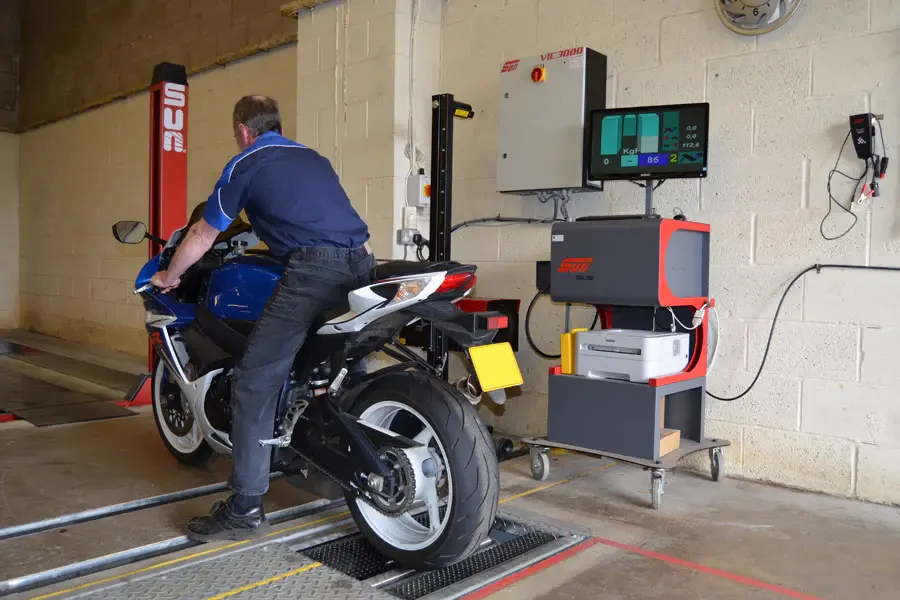
Interestingly, the motorcycle MOT doesn't currently include a universal numerical exhaust noise limit.
DVSA guidance instructs testers, where appropriate, to run the engine at around half its maximum speed and assess whether the exhaust noise is ‘clearly unreasonably above’ what would be expected from a similar motorcycle fitted with a standard silencer in average condition.
That inevitably introduces a degree of subjectivity.
An exhaust marked ‘NOT FOR ROAD USE’, ‘TRACK USE ONLY’ or similar should result in a Major defect, but an aftermarket exhaust isn't automatically an MOT failure simply because it is louder than the original.
This creates an unusual situation where a motorcycle may pass its MOT without anyone producing a sound meter, yet still potentially attract police attention for excessive noise once it returns to the road.
It's also one area where I can understand Jones' argument. If we're going to legislate against excessive vehicle noise, having a consistent way of defining and measuring it seems preferable to relying almost entirely on subjective judgement.
The question is where that line gets drawn.
Can you already be fined for a race exhaust?
Yes. Existing legislation already gives the authorities powers to deal with excessively noisy vehicles, and modifying an exhaust specifically to make a vehicle louder than its type-approved specification is prohibited.
Police don't therefore need an entirely new law simply to take action against an obviously illegal race exhaust. What they currently lack is the straightforward numerical roadside test Jones is calling for.
That distinction matters.
The debate isn't really about whether excessively loud exhausts should suddenly become illegal. It's about making existing rules considerably easier to enforce.
For riders with obviously antisocial exhaust systems, that might be difficult to argue against. For everyone else, however, the concern will inevitably be how far enforcement could eventually go.
Noise cameras aren't science fiction

Acoustic cameras might sound like something dreamed up specifically to terrify motorcycle Facebook groups, but they already exist.
The Department for Transport has previously trialled ‘noise camera’ technology in several locations around England, including Keighley, Bristol, Great Yarmouth and Rubery. The systems combine directional microphones with cameras, allowing them to identify a vehicle responsible for a particular noise event and record supporting evidence.
In theory, the principle isn't hugely different from speed enforcement. Rather than detecting a vehicle exceeding a speed threshold, the technology identifies one exceeding a noise threshold.
The difficulty is establishing that threshold and ensuring the technology can reliably identify the offending vehicle in busy traffic.
Britain isn't alone in exploring the issue either. France has experimented with acoustic enforcement systems, while Austria provides perhaps the more interesting example for motorcyclists.
Could Britain follow Austria?
Parts of the Austrian Tyrol already restrict motorcycles with a registered stationary noise figure above 95dB(A) from using certain roads during the summer months.
What's particularly significant is that the restriction can affect completely standard, legally homologated motorcycles.
That's where, for me, the argument begins to change.
There is an enormous difference between telling somebody that their illegally modified race exhaust is too loud for public roads and telling them that the perfectly legal motorcycle they purchased is now too noisy to use on a particular road.
One is enforcement of existing vehicle standards. The other is restriction of otherwise legal vehicles.
It also demonstrates why motorcyclists are understandably suspicious whenever discussions about vehicle noise resurface. Today's proposal may simply be aimed at obviously antisocial exhausts, but once infrastructure and enforceable noise limits exist, changing those thresholds becomes considerably easier.
Is there another way?
Perhaps the answer lies in looking more closely at the places generating the complaints in the first place.
If authorities know that hundreds of motorcycles or modified cars gather at the same locations every weekend, why not work with those communities rather than continually trying to disperse them?
Recognised meeting places could operate within sensible hours. Councils could work with pubs, cafés, dealerships and landowners to provide suitable locations away from densely populated residential areas. Organisers could promote basic behavioural standards, while police concentrate enforcement on dangerous riding, deliberate excessive revving and genuinely anti-social behaviour.
Noise curfews might also offer a more proportionate solution in particularly sensitive locations. I'd rather see sensible restrictions around a known residential hotspot during unsociable hours than nationwide rules designed around the behaviour of a minority in a handful of places.
We already accept that human activity creates noise. Airports, football stadiums, pubs, concerts, race circuits, parks and playgrounds all affect the people living around them. The solution isn't always to eliminate the activity; often it's about managing where, when and how it takes place.

Why should enthusiast vehicle gatherings automatically be treated differently?
We don't exactly help ourselves
Motorcyclists do need to accept some responsibility.
If we don't want increasingly restrictive legislation, continually providing evidence for why it might be necessary isn't particularly clever.
Nobody needs to bounce a superbike off its limiter when leaving a bike meet. Nobody needs to repeatedly accelerate through a residential area at midnight simply because a tunnel makes their exhaust sound nice. And fitting something resembling a piece of scaffold tube directly to the headers before shouting ‘loud pipes save lives’ probably isn't going to win over many local residents.
There has to be a middle ground.
I like motorcycles that sound like motorcycles. A V4, V-twin, triple or screaming inline-four is part of what makes these machines special, and I don't particularly want every combustion-engined vehicle reduced to the acoustic presence of a dishwasher.
At the same time, I can understand why someone putting their children to bed doesn't want a succession of motorcycles being hammered past their bedroom window at midnight.
Those positions aren't contradictory.
So, is Donna Jones right?
More than I initially expected.
If an exhaust is already illegal, providing police with a consistent and objective way of proving it seems entirely reasonable. In fact, I'd probably rather know that a defined decibel figure measured under clearly specified conditions constitutes an offence than leave the decision entirely to individual interpretation.

What matters is the detail.
Any roadside standard needs to establish exactly how noise is measured, at what distance, under what engine conditions and how different motorcycles are treated. It needs to account for older machines and ensure a completely standard, homologated motorcycle cannot suddenly find itself effectively illegal because the enforcement method differs from the test under which it was approved.
Noise cameras would also need to demonstrate that they can reliably identify individual offending vehicles rather than simply recording a noisy environment.
Most importantly, enforcement needs to remain focused on the problem it was supposedly introduced to solve.
The Hampshire story originates from complaints surrounding known gathering hotspots. If the underlying issue is repeated anti-social behaviour in those locations, then perhaps that's where enforcement should start.
Target the people behaving irresponsibly. Enforce the laws that already exist. Create sensible places for enthusiasts to meet. Introduce proportionate local restrictions or curfews where there is a genuine and persistent problem.
And perhaps remind the small minority within our own community that 14,000rpm outside someone's house at midnight isn't a fundamental human right.
Motorcycles are emotional, mechanical and gloriously unnecessary things. Noise has always been part of their character, and I don't think wanting your motorcycle to sound good automatically makes you anti-social.
Sometimes the problem isn't how loud the bike is.
It's knowing when – and where – to turn the volume down.


Comments