


Triumph Street Triple 765 RX & Moto2 Editions 2026


From Accidental Icon to Track-Focused Question Mark
When the original Triumph Street Triple 675 arrived, it felt less like a calculated product launch and more like a happy accident. A naked bike built from Daytona parts shouldn’t have been quite that good — yet it was. Light, compact and unintimidating, it combined everyday comfort with a sense of precision that few middleweights could touch.
The seat height was friendly, the riding position natural, and the chassis confidence-inspiring without ever feeling dull. But it was the engine that sealed the deal. Triumph’s three-cylinder was creamy, elastic and full of character, delivering usable performance wrapped in one of the best soundtracks of the era. It wasn’t just quick — it was rewarding.
The result was one of the most popular mid-capacity sports nakeds of its time, a bike that appealed to new riders and experienced ones in equal measure. Crucially, it didn’t ask you to compromise. It worked on real roads, in real conditions, ridden by real people.
A Benchmark That Grew Up Gracefully
What’s impressive is how well the Street Triple has aged. Over successive generations it hasn’t chased trends, but quietly refined its original formula. Power increased. Electronics improved. Styling sharpened. The chassis became more focused without losing its balance.
MotoGP-inspired graphics, R and RS variants, and occasional limited editions added credibility rather than gimmickry. Unlike many long-running nameplates, the Street Triple didn’t dilute its identity — it sharpened it.
Which is why the arrival of the new Triumph Street Triple 765 RX feels both exciting and… slightly confusing.
A £13,000 Naked Bike in a Changing Market
At just under £13,000, the RX exists in a very different world to the bike that made the Street Triple famous. The middleweight naked market has shifted dramatically. Most manufacturers are now pushing parallel-twin sports nakeds under £8,000, making around 90–100bhp — bikes that are light, affordable, and more than fast enough for the road.
These are the bikes people are actually buying.
By contrast, the RX’s supposed competition — Yamaha’s MT-09 SP, Ducati’s Monster SP, Suzuki’s GSX-S750, Kawasaki’s Z900 — all feel slightly niche. Fast, capable machines, yes, but rarely used anywhere near their potential. They occupy a premium space that makes sense on spec sheets, but less so on UK roads.
So the question becomes unavoidable: who is the 765 RX really aimed at?
The Track Weapon Narrative
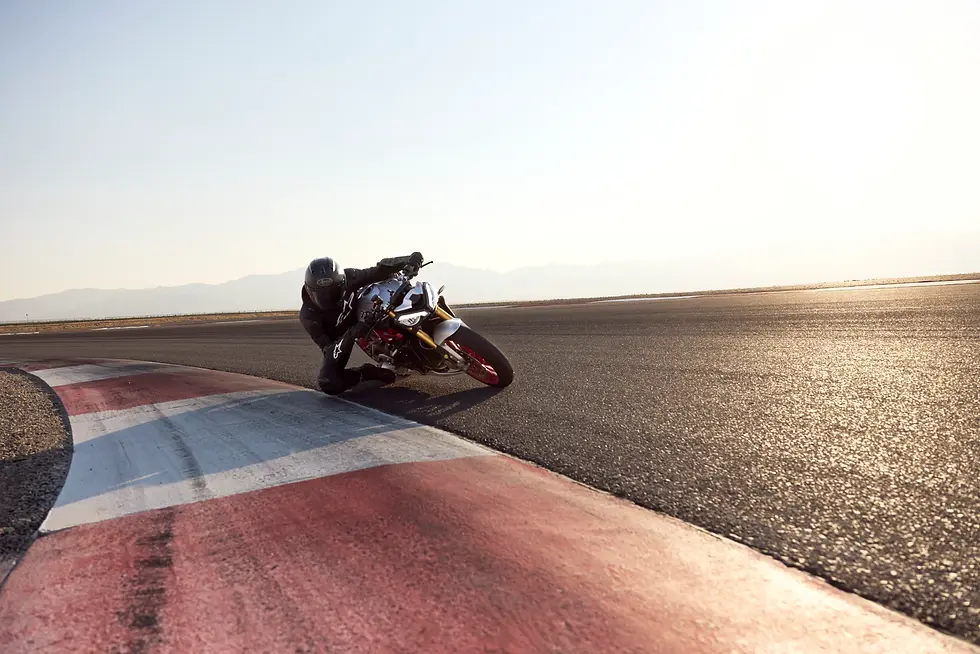
Triumph’s answer appears to be clear. The RX is being marketed heavily as a track-focused machine, a naked bike with race DNA, exploiting the brand’s Moto2 involvement and the performance credibility that comes with it.
On paper, it stacks up. The engine is derived directly from Triumph’s Moto2 programme. Suspension and brakes are top tier. The chassis is stiff, sharp and ready to be pushed.
But in the real world, naked bikes are still a rarity at track days. Most riders who take circuit riding seriously choose fully-faired sports bikes — for wind protection, ergonomics, body position and consistency over long sessions. Even riders who love nakeds on the road often switch to sports bikes on track.
That’s what makes the RX’s positioning feel slightly at odds with reality. If Triumph truly wanted to capitalise on its Moto2 pedigree, why not build a proper Moto2-replica sport bike? A lightweight, fairing-clad machine designed unapologetically for the circuit, rather than asking riders to accept compromises.
The Moto2 Edition: Exclusivity Without Substance?

The confusion deepens with the Moto2 Edition, which asks roughly another £2,000 for modest cosmetic upgrades and exclusivity. While it undoubtedly looks the part, the value proposition feels thin. It doesn’t fundamentally change how the bike rides or who it’s for — it simply narrows the audience further.
In a segment already struggling to justify its price, that’s a bold move.
And Yet… The Street Triple 7565 RX Endures
Despite all of this, it’s impossible not to admire the Street Triple. Few bikes manage to blend performance, usability and character as effectively. The triple-cylinder engine remains one of the most engaging in motorcycling, and the chassis balance is still a benchmark.
In fact, the RX’s biggest strength might be the very thing Triumph is overthinking. The Street Triple doesn’t need to be a track bike. It’s at its best when it’s allowed to be what it has always been: a brilliantly fast, deeply rewarding road bike that can handle a track day — not one that’s defined by it.
Ironically, I’d love to ride one on circuit, not because I think it’s the ideal tool, but because I’m genuinely curious. Could a modern sports naked be just as fun as a dedicated sports bike? Could the upright ergonomics and torque-rich triple offer a different kind of thrill, even if the lap times suffer?
That curiosity says everything.
A Legend Searching for a Label
The Street Triple’s journey from 675 hero to 765 RX has been one of evolution, not decline. But the RX feels like a bike searching for a label it doesn’t really need. Its legacy was built on accessibility, balance and real-world brilliance — not on chasing lap times or racing associations.
Triumph hasn’t lost its way. But it may have forgotten that the Street Triple was never great because it was extreme.
It was great because it was right.

Comments