


Your Bike Is Stolen. The Police Give You a Reference Number. Who Pays for the Rest?


Three incidents I’ve witnessed have left me asking whether motorcycle theft is being treated with anything like the urgency riders feel.
An 18-year-old rider stops at a red light on his way home from work. It is broad daylight. Cars are all around him. Two unregistered electric off-road bikes pull up, one on either side. A passenger gets off with a hammer and tries to force him off his 125.
He escapes. He keeps his bike. But he never rides it to work again.
I’ve spent years around motorcycles, and theft feels more brazen to me than I can remember. Social media undoubtedly puts more incidents in front of us, so I’m wary of claiming that theft everywhere is rising. What I can tell you is what happened in three cases I know firsthand, and what it cost the people involved even when they got their bikes back.
I’ve changed identifying details. These are accounts of what the victims experienced, rather than a review of police records or the decisions made behind the scenes.
The rider who got away
I’ll call the young rider Tony. He worked at our dealership and had paid more than £3,000 for his nearly new 125. Insurance alone cost him over £1,200 a year. He had worked hard for every bit of it.
At the lights, surrounded by traffic and witnesses, a passenger from one of the electric bikes threatened him with a hammer. Tony struggled, ran the red light to escape and was briefly pursued. The other bikes couldn’t keep up.
He reported the attempted robbery by phone and says he was directed to an online form. After 10 to 15 minutes trying to complete it, he gave up.
Tony subsequently passed his car test. He no longer rides to work and doubts he will take his full motorcycle test. The thieves did not get the bike, but they may still have driven a young rider out of motorcycling.
The bike wheeled out of a showroom
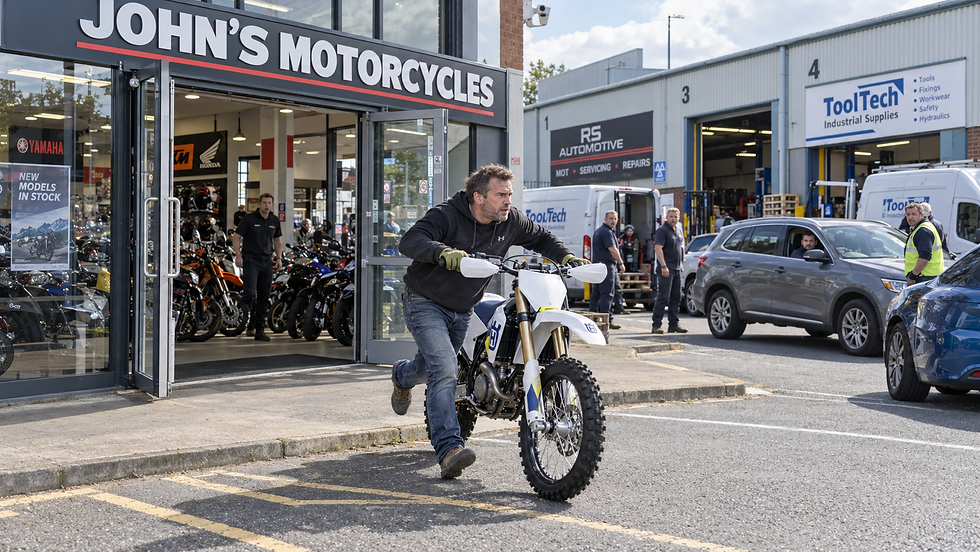
On a quiet Monday morning, a man walked into a busy motorcycle dealership. Staff and customers were present. Cameras recorded his approach and his movements inside.
Within roughly a minute of entering, he wheeled a brand-new, unregistered bike through the open doors, ran it across the car park and coasted away. Staff discovered it missing around 10 to 15 minutes later.
The dealership gathered footage from its own cameras and neighbouring businesses and contacted the police. It says it was directed to report the theft online. After 48 hours without an update, it called again and spent around 25 minutes on hold. It was told an officer might visit for the footage or that a secure upload link might be sent.
A week later, the dealership had received a crime reference number but, to its knowledge, no request for the footage and no visit. The bike has not been recovered.
The loss did not end with the value of the motorcycle. Security had to be tightened. Working practices changed. Staff morale took a hit. Insurance became more expensive. Every one of those costs lands on a business already trying to keep bikes affordable for its customers.
The scooter stolen twice

The third rider parked his large maxi-scooter on his girlfriend’s driveway at around 6pm on a summer evening. It was his only form of transport. It had a steering lock and a tracker.
A group arrived on bicycles, broke the steering lock and pushed the scooter away. The owner received a movement alert and called the police. He says he was told no one could attend and was advised not to search for it himself.
The tracker led to the scooter, hidden in an alley a little over a kilometre away. It was damaged. The repair cost around £400, which the owner paid himself after notifying his insurer. He says police did not attend or ask for the available CCTV.
Months later, the same scooter was stolen again, this time from under a cover at the side of the house. The tracker showed a location more than two kilometres away. The owner reported it and, worried about losing his transport altogether, went looking with friends. They found the tracker without the scooter, then located the damaged bike inside a locked van body nearby.
Again, he says police did not attend. Recovering an unrideable motorcycle became his problem too.
I cannot say whether prompt attendance would have caught anyone in any of these cases. I can say that, from the victims’ side, the experience felt like doing the investigative work themselves and then paying for the consequences.
The figures behind the frustration
These stories are personal, but the wider outcome figures explain why they strike a nerve. In England and Wales, 83.2% of recorded vehicle offences closed in the year ending March 2026 had no suspect identified. Just 2.8% resulted in a charge or summons. That category covers theft from vehicles and vehicle interference as well as theft of vehicles; it is not a motorcycle-specific detection rate.
The Metropolitan Police also says that more than 9,000 scooters, motorcycles and mopeds were stolen in London in the preceding year. That is one city and one police force’s published figure, not a national estimate, but it shows the scale riders are living with.
I know officers face competing calls and finite resources. I also know that a crime reference number is useful for an insurance claim. But when a victim has a tracker location, several camera angles or an identifiable route away from a showroom, it is reasonable to ask what happens next. How quickly is evidence collected? Who reviews it before footage disappears? When are repeat thefts connected?
These are questions for police leaders and government as much as for the officer answering a phone.
Another cost of getting into bikes
In my piece on the cost of starting out on a 125, I argued that getting into motorcycling should be exciting, not eye-wateringly expensive. Tony’s numbers show how precarious that first step can be: more than £3,000 for the bike and over £1,200 a year to insure it, before kit, training, servicing, fuel or security.
The government has acknowledged that vehicle theft and repair costs contribute to motor insurance prices. That does not mean every rider’s premium rises automatically after a theft, or that insurers profit from it. It does mean crime has a cost that can spread far beyond the person whose bike disappears.
I’ve also written about the barriers created by our motorcycle licensing system and questioned proposals for greater enforcement of motorcycle noise. Road safety and excessive noise are legitimate issues. My frustration is with the balance riders experience: another test to pay for, another restriction to navigate, another potential penalty to worry about—while someone can wheel a bike away in daylight and the owner is left chasing an update.
I cannot prove that these rules are designed to raise money for government, and it would be too easy to claim that every fine is a cash grab. But government should understand why riders ask where the same energy goes when they are the victims.
What are we expecting people to do?
This is where the argument gets uncomfortable. What if Tony had taken the hammer and seriously injured his attacker? What if a staff member had tackled the showroom thief and he had cracked his head on the floor? Would those incidents have received an immediate response?
Those are questions about priorities and consequences, not encouragement to confront thieves. The scooter owner should not have felt he needed to search fields and van bodies with his friends. The dealer should not have been left wondering whether anyone wanted the CCTV. Tony should not have had to wrestle with a form after being threatened at traffic lights.
And telling insurers about a theft or riding uninsured cannot be the answer. It would put even more cost and risk on the same people already carrying it.
Here is what I want to see: a clear route for victims to submit time-sensitive footage and tracker information, timely decisions about whether police will act on it, and an explanation when they cannot. I want repeat locations and patterns investigated, and I want forces to tell the public what happens to motorcycle theft reports after the reference number is issued.
Theft can take a bike in minutes. Its effects can last years: higher costs, changed routines, fear of parking outside, and sometimes a rider who gives up altogether.
If you’ve had a motorcycle stolen or recovered one yourself, what response did you get—and what would have made a real difference?


Just a comment on your stolen motorcycle report there. Just saying when I did recovery Lancashire I had 999 operators say they will file a report give me the crime ref number and say that’s all we can do when we get theses calls we just leave it to insurance. Which I sick and twisted no wonder insurance prices are so high.