


2027 Honda CBR500R FOUR – Now THIS Is Exciting! But Is It the End of the CBR500R?

Just when I was beginning to think Honda had forgotten how to surprise us, it announces the 2027 CBR500R FOUR. A brand-new, 72bhp, high-revving inline-four sports bike with E-Clutch, a low seat and some seriously tempting specifications. I genuinely didn't see this coming, and I reckon it could be one of the most entertaining motorcycles Honda has launched in years.
I've just finished writing about my disappointment with the 2027 CBR600RR.
A perfectly brilliant motorcycle, but one that fundamentally sticks to a formula Honda has been refining for more than twenty years.
And then Honda goes and announces this.
The CBR500R FOUR.
A proper little four-cylinder sports bike with an engine that revs to 12,500rpm, a compact chassis, sporty styling and a specification that suggests Honda has remembered something incredibly important.
Motorcycles don't have to be ridiculously powerful to be ridiculously good fun.
And I've got a feeling this thing could be an absolute riot.
A Proper Little Screamer!
Let's start with the engine, because that's what makes this motorcycle so interesting.
Forget the familiar parallel-twin engine found in the existing CBR500R.
The new FOUR gets a 502cc, 16-valve, DOHC inline-four, developed from Honda's Japanese-market 400cc four-cylinder platform.
And the numbers are rather interesting.
Specification | 2027 CBR500R FOUR |
Engine | 502cc inline-four |
Maximum power | 72bhp (53kW) at 11,000rpm |
Maximum torque | 47.4Nm at 9,750rpm |
Redline | 12,500rpm |
Kerb weight | 189kg |
Seat height | 780mm |
Gearbox | Six-speed with standard E-Clutch |
Fuel capacity | 14 litres |
Claimed top speed | 130mph (210km/h) |
A2 option | 35kW version available |
Now, 72bhp might not sound particularly exciting in a world where superbikes are producing more than 200bhp.
But that's missing the point entirely.
This is a motorcycle designed to be ridden hard, to be worked through the gearbox and to reward riders who enjoy extracting performance rather than simply twisting the throttle and hanging on.
Peak power arrives at 11,000rpm, with maximum torque at 9,750rpm.
That tells me everything I need to know about where the fun is going to happen.
And Honda has given it dual ram-air intakes, downdraft induction and a 4-2-1 exhaust system inspired by the original CB400 FOUR.
I can almost hear the thing screaming down the straight at Cadwell Park already.
This is exactly the sort of engine that makes you want to ride a motorcycle for absolutely no reason whatsoever.
Is This the Death of the Existing CBR500R?
Here's the question I immediately asked myself.
What happens to the existing CBR500R?
Because, unless Honda has a very clever pricing strategy up its sleeve, I struggle to see how the two motorcycles comfortably coexist.
The current CBR500R uses a 471cc parallel-twin producing 35kW, or approximately 47bhp.
It's an excellent A2 sports bike.
Approachable, economical, reliable and sufficiently sporty to keep newer riders entertained without being intimidating.
But the new FOUR offers an entirely different proposition.
An extra 25bhp in unrestricted form, a high-revving four-cylinder engine, more sophisticated electronics and Honda's E-Clutch system as standard.
And crucially, Honda is also offering a 35kW A2-compliant version.
So the new bike potentially appeals to the same A2 riders as the existing CBR500R, while also attracting fully licensed riders looking for something more exciting.
Why would you choose the twin?
Well, price could be one very good reason.
The existing CBR500R should remain cheaper to produce, and its more accessible engine characteristics could still make it a better everyday motorcycle for some riders.
There's also the question of insurance, running costs and fuel economy.
But if Honda can price the FOUR competitively, I can see the existing twin-cylinder CBR500R having a difficult time justifying its place in the range.
Honda hasn't announced that the current CBR500R is being discontinued, but I certainly wouldn't be surprised if this new model eventually replaces it.
And if it does, I don't think many enthusiasts will complain.
The New Small Sports Bike War Is Getting Interesting
What's particularly exciting is how competitive this segment is becoming.
BMW has been developing its new small-capacity sports bike offering, with the F 450 platform bringing fresh interest to the class.
Then there's Kawasaki's Ninja ZX-4RR, which has already demonstrated just how entertaining a small-capacity four-cylinder sports bike can be.
And of course, the Aprilia RS 457, CFMOTO 450SR and KTM RC 390 all offer their own interpretations of affordable, lightweight sports bike performance.
But Honda's approach is particularly interesting.
Rather than relying on a twin-cylinder engine with a relatively broad torque curve, Honda has embraced the character of a high-revving four-cylinder.
And that gives the CBR500R FOUR something special.
It's not simply about how quickly you can accelerate from one corner to another.
It's about the experience of doing it.
The sound.
The engine screaming towards the redline.
Working through the gears.
Keeping the engine in its sweet spot.
That's what made the little 400cc sports bikes of the 1990s so entertaining.
And it's exactly what I hope Honda has managed to recreate here.
Mallory Park and Cadwell Park – This Could Be Brilliant!
I can already picture where I'd want to ride this motorcycle.
Mallory Park.
Cadwell Park.
Small, technical circuits where outright horsepower matters far less than corner speed, confidence and the ability to maintain momentum.
I've raced enough motorcycles to appreciate that you don't necessarily need a hugely powerful machine to have an enormous amount of fun on a racetrack.
In fact, sometimes less power makes the experience more rewarding.
On a big superbike, you can compensate for a poor corner exit by opening the throttle and letting the engine do the work.
On a smaller motorcycle, you have to earn your speed.
Your lines matter.
Your braking points matter.
Your corner speed matters.
And keeping a high-revving four-cylinder singing through a sequence of bends can be incredibly satisfying.
At 189kg, the CBR500R FOUR isn't exceptionally light. In fact, it's only a little lighter than the new CBR600RR.
But with a 160-section rear tyre, compact dimensions and a chassis specifically designed for agility, it could still feel wonderfully nimble.
The 41mm KYB upside-down forks, aluminium swingarm, Pro-Link rear suspension and twin 296mm front discs with radial-mounted Nissin calipers all suggest a sensible sporting package.
The suspension isn't particularly exotic, and the forks aren't adjustable, but that doesn't automatically mean it won't handle beautifully.
What matters is how well Honda has put everything together.
And Honda has a pretty good track record when it comes to creating balanced motorcycles.
I suspect the CBR500R FOUR could be one of those bikes where you're having an absolutely fantastic time without needing to reach ridiculous speeds.
Give me one of these at Cadwell Park for a day and I reckon I'd come back grinning like an idiot.
A Proper Sports Bike for Shorter Riders
Another detail that immediately caught my attention was the seat height.
Just 780mm.
That's refreshingly low for a motorcycle with genuine sporting ambitions.
And it could make the CBR500R FOUR particularly appealing to riders who struggle with the increasingly tall seat heights found on many modern motorcycles.
Honda has also designed the subframe and seat area to make reaching the ground easier.
Of course, seat height isn't everything. Seat width, suspension sag and individual leg proportions all influence how easily you can get your feet down.
But a 780mm starting point is encouraging.
Combine that with a relatively narrow rear tyre, manageable power delivery and Honda's reputation for predictable handling, and this could be a genuinely confidence-inspiring motorcycle.
Not just for younger or newly qualified riders, either.
There are plenty of experienced motorcyclists who simply don't want a huge, heavy machine.
Some people want a smaller bike they can enjoy without wrestling with it every time they stop.
And there's absolutely nothing wrong with that.
E-Clutch as Standard? That's a Clever Move
Honda has also fitted its E-Clutch system as standard.
And I think that's a particularly smart decision.
For anyone unfamiliar with the technology, E-Clutch allows you to pull away, stop and change gear without operating the clutch lever.
You still have a conventional six-speed gearbox and a gear lever.
You simply don't need to use the clutch manually unless you want to.
And you can use the clutch lever normally whenever you choose.
On the CBR500R FOUR, the system works alongside throttle-by-wire technology, allowing automatic throttle blipping during downshifts and helping manage rear-wheel instability under aggressive braking.
That's potentially brilliant on a motorcycle designed to be enjoyed through the gears.
Imagine approaching the Mountain section at Cadwell, dropping a couple of gears without touching the clutch and letting the electronics match the engine speed.
Or simply enjoying a spirited Sunday ride without constantly working the clutch through villages and traffic.
Some purists will undoubtedly complain.
But I suspect many of them will change their minds once they've actually ridden it.
And for newer riders, removing one of the more demanding elements of low-speed motorcycle control could make the experience considerably more approachable.
Technology Without the Superbike Price Tag?
The equipment list is surprisingly comprehensive.
Honda has included a five-inch colour TFT display with RoadSync smartphone connectivity, USB-C charging, three standard riding modes and two customisable user modes.
You can adjust engine power, engine braking and traction control intervention.
There's also two-channel ABS, LED lighting and Pirelli Diablo Rosso IV tyres as standard.
That's a pretty impressive specification for a motorcycle Honda is positioning as an attainable middleweight sports bike.
But there's one rather important detail missing.
The price.
Honda's press release repeatedly talks about affordability and value for money, but we haven't yet been given a confirmed UK figure.
And that could make or break this motorcycle.
Because if Honda prices it too close to the CBR600RR, buyers might reasonably question whether they're better off spending a little more for the additional performance and more sophisticated chassis.
Equally, if it becomes significantly more expensive than the existing CBR500R, it risks losing some of the accessibility that makes the smaller-capacity sports bike market so appealing.
Get the price right, though, and Honda could have a genuine winner on its hands.
This Is the Honda I Want to See More Of
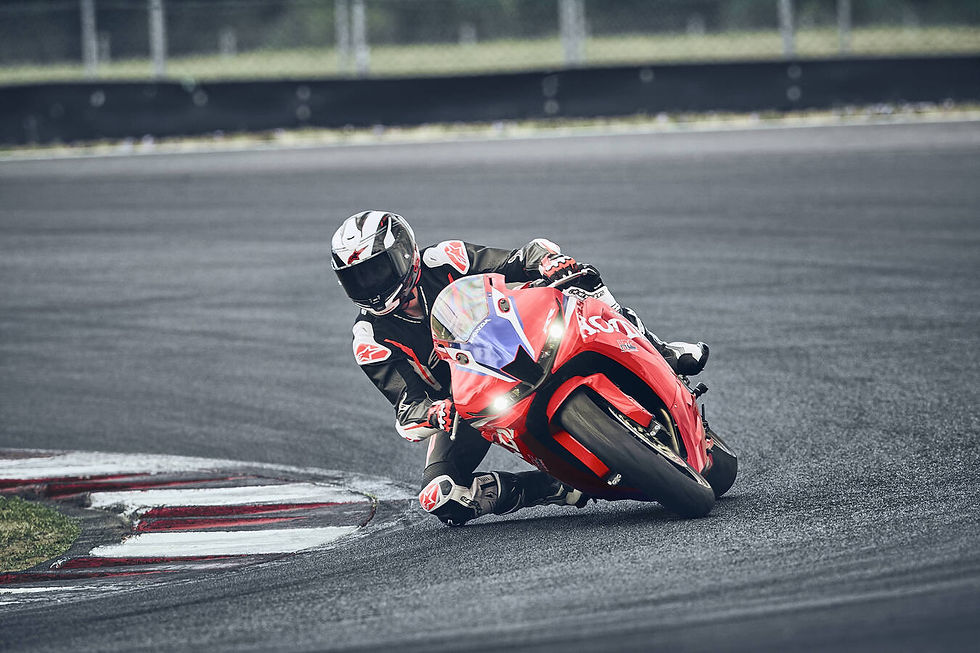
What's funny is that this announcement has arrived alongside the updated 2027 CBR600RR.
And the contrast couldn't be more interesting.
The CBR600RR is an exceptionally capable motorcycle that Honda has chosen to refine rather than reinvent.
The CBR500R FOUR, meanwhile, feels like something genuinely fresh.
A motorcycle that doesn't exist simply to chase bigger horsepower figures or faster lap times.
It's designed to deliver enjoyment.
And perhaps that's something the motorcycle industry has occasionally forgotten.
Not everybody wants a 200bhp superbike.
Not everybody needs electronically controlled suspension, enormous winglets or enough performance to embarrass a MotoGP bike from twenty years ago.
Sometimes you just want a motorcycle that makes you laugh inside your helmet.
Something that encourages you to work through the gears, carry corner speed and enjoy every mile.
And that's exactly what I hope the CBR500R FOUR delivers.
My Verdict – I Want a Go on One. Immediately.
I didn't expect this motorcycle.
And perhaps that's why I'm so excited about it.
The CBR500R FOUR combines some of the best ingredients from Honda's history with the technology and usability modern riders expect.
A screaming inline-four engine.
A compact sports chassis.
A genuinely accessible seat height.
Modern electronics.
E-Clutch.
And enough performance to make it entertaining on both the road and the racetrack.
There are still questions to answer.
At 189kg, it isn't particularly lightweight.
The suspension specification is fairly conventional.
We don't know the UK price yet.
And we don't know whether Honda intends to retain the existing twin-cylinder CBR500R alongside it.
But none of those questions really dampens my enthusiasm.
Because unlike the CBR600RR, which left me wondering why Honda hadn't done something more adventurous, this is exactly the sort of motorcycle I want manufacturers to build.
Not necessarily faster. Not necessarily more powerful. Just more fun.
I genuinely think this could become one of the most entertaining small sports bikes on the market.
And I would absolutely love to take one around Mallory Park or Cadwell Park to find out.
Honda, if you're listening, I'll happily volunteer.
What Do You Think?
Is the CBR500R FOUR the small sports bike we've been waiting for?
Would you choose this over a Kawasaki Ninja ZX-4RR, BMW's upcoming small sports bike or the existing CBR500R?
And perhaps most importantly, do you think this spells the end for Honda's twin-cylinder CBR500R?
Let me know in the comments.
Ben – Get Ben Riding
Source: Honda Motor Europe, official 2027 CBR500R FOUR press release, 20 October 2026. Specifications are provisional. UK pricing and the future of the existing CBR500R have not been confirmed.

Comments